The Sensation That Stays
There is a feeling that most people who have run farm equipment for a long season would recognize, even if they have never named it. You finish for the day, set the handles down, and your hands keep vibrating. Not literally, or not quite, but close enough that it takes a while to feel like your hands are your own again. You notice it when you pick up a glass of water. You notice it when you are trying to feel for something in your pocket. After a while, you stop noticing it at all, because it has become the ordinary texture of the end of a workday.
That is where the problem begins. Or rather, that is where the problem has already been going on for a while without anyone tracking it.
Hand-arm vibration syndrome, known in the literature as HAVS,
is an occupational disease caused by prolonged, repeated exposure to vibration transmitted through tools or machinery into the hands and arms. It is well-documented in construction, mining, and forestry. It is also well-documented in agriculture, though it tends to get less attention there, in part because farming has a long history of absorbing occupational injury as a condition of the work rather than a consequence of the equipment.
The condition moves through the body in overlapping ways. The vascular component is what most people associate with the name: vibration white finger, or Raynaud's phenomenon, where blood vessels in the fingers constrict and the affected fingers go white, then blue, then red as circulation returns. It is typically triggered by cold and can be painful. The neurological component involves numbness, tingling, and reduced sensitivity in the fingertips, which sounds minor until you consider how much precision farm work requires, how often you are handling seedlings or adjusting equipment by feel in conditions that are not ideal for reading fine detail. The musculoskeletal component affects grip strength, joint health in the wrists and elbows, and the ability to sustain the kind of physical work that farming requires over years and decades.
None of these arrive all at once.
HAVS develops in stages over years of cumulative exposure. The UK Health and Safety Executive, which has published some of the most detailed guidance on the condition, describes an early stage characterized by occasional tingling and numbness, progressing through stages where the vascular attacks become more frequent and occur in warmer conditions, and eventually to a stage where grip strength is measurably reduced and the symptoms are effectively permanent. Most people, by the time they notice something is wrong in a way that prompts them to name it, are already some distance into that progression.
There is a threshold regulators have tried to define:
A daily vibration exposure of 2.5 meters per second squared, the action value established under the EU Physical Agents Directive. Above that level, the risk begins to accumulate meaningfully. Walk-behind tractors, depending on the implement, the terrain, and the operating speed, can produce handle-transmitted vibration levels well above it. Measurements taken during tillage work have found values that in several cases exceeded 5 m/s², the directive's upper limit, meaning a farmer could reach a day's worth of meaningful exposure in a few hours of field work. An afternoon of bed preparation is not an unusual day on a small diversified farm.
The geometry of walk-behind equipment makes the exposure hard to avoid.
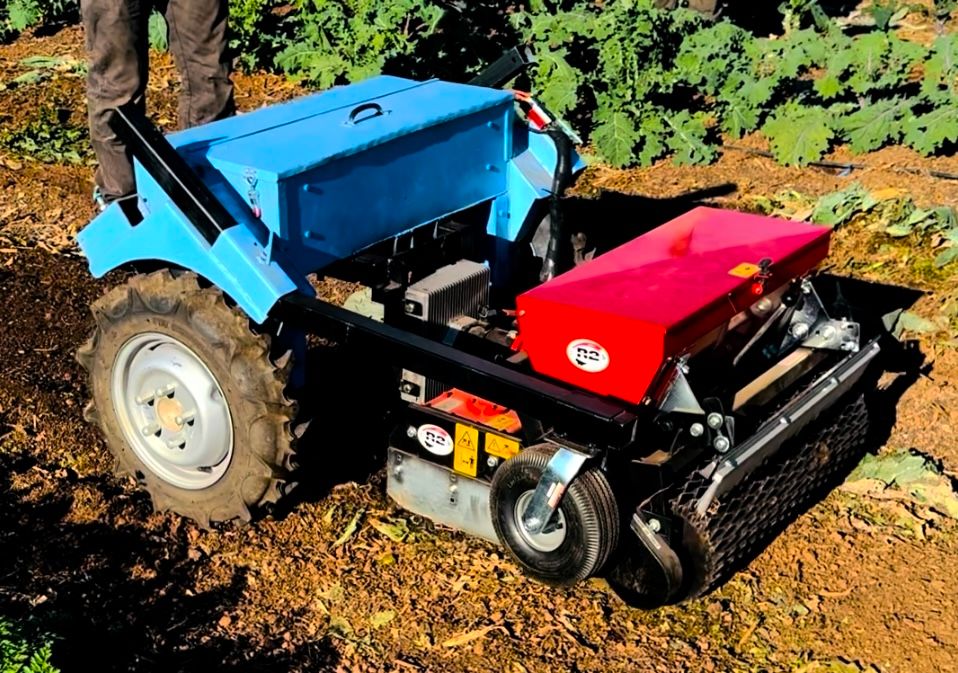
Unlike a ride-on machine, where the seat and cab absorb some fraction of the vibration before it reaches the operator, a walk-behind tractor transfers it directly through the handles into the palms, through the wrists, and up the arms. You are the vibration damper. Whatever the implement is doing to the soil, a portion of that force is traveling into your hands for as long as you are operating. On a small farm where one or two people are doing most of the field work, that is a lot of accumulated hours over a growing season, and a lot of accumulated seasons over a career.
OSHA's general industry standards for vibration exist, but the agency has not established a specific permissible exposure limit for hand-arm vibration in the United States, and the agricultural exemption that limits OSHA's reach on farms with fewer than eleven employees means that most small farms operate outside the scope of any formal monitoring requirements. There is no one tracking cumulative exposure. There is no required medical surveillance. Farmers who develop symptoms tend to manage them individually, as they manage most things, and often attribute the progression to age or to the general wear of physical work.
Research that has looked directly at agricultural workers has found what you might expect: farmers carry a significant burden of this condition, with rates of vibration-related hand and arm symptoms higher than most other occupational groups, and walk-behind equipment specifically identified as a significant exposure source. The farm population sits alongside forestry and construction workers in the higher-risk categories, which is not a category most people outside those industries know exists.
What makes this particular harm easy to overlook is the same thing that makes occupational noise-induced hearing loss easy to overlook: it does not happen on a specific day. There is no incident. There is no moment you can point to. There is just the work, repeated over years, and then at some point the tingling does not go away when the work stops, and the grip is not quite what it was, and cold mornings require a few minutes before the fingers cooperate. Farmers are adaptive, practically by definition. The adaptation tends to happen quietly, incrementally, without anyone in a position to observe it from the outside connecting the symptoms to the equipment.
The case for reducing vibration exposure is compelling.
The research on HAVS is decades old and consistent across industries and countries. The harm is real, cumulative, and largely irreversible once it has progressed past the early stages. For operators running walk-behind equipment through a full growing season, the exposure adds up faster than most people realize, and unlike a machine that breaks down and announces its failure, the body tends to absorb the damage silently until it cannot.
Equipment design is not the only variable, but it is a significant one. The amount of vibration transmitted to the operator depends on how the machine generates force, how that force is transferred through the frame and handles, and what the handles themselves are made of and how they are mounted. These are engineering choices, not fixed properties of farm work. Electric drivetrains eliminate the combustion-driven vibration that is inherent to gasoline and diesel equipment. That is one less source of cumulative harm that operators of conventional walk-behind tractors carry with them at the end of every working day, whether or not they have a name for it yet.
Sources
- Health and Safety Executive (HSE), "Hand-arm vibration: the control of vibration at work regulations 2005," hse.gov.uk
- European Parliament, Directive 2002/44/EC on the minimum health and safety requirements regarding the exposure of workers to the risks arising from physical agents (vibration)
- Katharine M. Palmer et al., "Vibration syndrome in forestry commission chain saw operators," British Journal of Industrial Medicine, 1976
- Meyers et al., "Vibration-related symptoms in a US farmer cohort," American Journal of Industrial Medicine
- Journal of Agricultural Safety and Health, walk-behind tractor vibration measurement studies
- NIOSH, "Criteria for a Recommended Standard: Occupational Exposure to Hand-Arm Vibration," 1989, CDC