The Quiet Nobody Talks About
You probably know a farmer who speaks too loudly. Not because they are hard of hearing in the way you describe someone who needs things repeated, but in the way that becomes background, the way a voice carries past what the room requires. You stop registering the volume after a while. It is just how they talk.
But, it isn’t “just how they talk.” It is what decades behind a tractor engine does to the way you process sound. It happens slowly enough that by the time anyone notices, the damage has been done for years.
Agriculture and forestry have some of the highest rates of occupational hearing loss of any industry in the United States.
A NIOSH analysis drawing on National Health Interview Survey data found that among workers in this sector, 20% reported hearing difficulty and 13% reported tinnitus, a persistent ringing or buzzing that does not go away, the highest of any industry studied. A 2025 scoping review published in Frontiers in Public Health, which examined 66 years of research on the subject, concluded plainly that the problem has not decreased over time.
The pattern is straightforward: Noise-induced hearing loss is cumulative and permanent. Every hour of exposure above the threshold adds to the total. The damage does not announce itself with pain. It does not give you warning signs that most people would recognize as warning signs. You lose the higher frequencies first, then the ones that carry consonants, the sounds that make speech intelligible in a noisy room. Then you start asking people to repeat themselves. Then you stop bothering, because you have gotten good at nodding.
NIOSH recommends limiting exposure to 85 decibels for no more than eight hours a day.
At 88 decibels, the safe exposure time drops to four hours. At 91 dB, two hours. Walk-behind diesel tractors typically operate between 90 and 98 decibels at handle height. A farmer running that equipment through a bed preparation cycle in the morning and another cultivation pass in the afternoon has often crossed the threshold before lunch.
The setup on small farms makes the exposure harder to escape. Most workers in high-noise environments have some structural distance from the source. A factory floor. A cab with some insulation. A machine that stays in one place while the worker moves around it. Walk-behind equipment puts you directly behind the engine, hands on the handles, at exactly the height where exhaust and sound concentrate. You are not near the noise. You are in it, for hours, leaning into it, while it vibrates through the handles into your palms and up through your arms. The vibrating sensation lasts long after your work has stopped for the day, and so does the damage to your hearing.
And because most small farms are family operations without formal safety programs, there is no one tracking cumulative exposure. No audiometric testing. No rotation schedule. OSHA's hearing conservation standards, which require employers in industrial settings to monitor noise above 85 dB and provide hearing protection, largely do not apply to agricultural workers on farms with fewer than eleven employees. Which is to say, they do not apply to most farms. Researchers from New Zealand studied 586 farm workers across 60 farms, and found that driving tractors without cabs was one of the strongest risk factors for measurable hearing loss, alongside age and working with metal. The association was not subtle and it was consistent across the sample.
There is a version of this post that would pivot here to solutions: ear protection, quieter equipment, exposure monitoring. All of that is true and deserves a mention. But the more interesting thought is how thoroughly this particular harm has been absorbed into the category of things that are just part of farming. It's so common, we rarely name what this damage has become: one more permanent injury that we treat as normal.
You get used to it. You get used to the ringing after a long day, the way conversation in a loud room becomes effortful, the habit of positioning yourself so you can see someone's face when they talk. It does not feel like an injury because it did not happen at once. It felt like Tuesday, and then like another Tuesday, and then like all the Tuesdays for thirty years.
Noise-induced hearing loss is described in the research literature as insidious, meaning it progresses without the person being aware of the progression.
Most people do not recognize it as a serious problem until it is already moderately severe. By that point, the damage is done. There is no treatment. There is no restoration. There is only adaptation, which farmers are very good at, and so maybe that is part of why this particular harm stays so quiet.
The case for quieter equipment is not just environmental or technological. It is this: the person behind the machine is absorbing real damage with every hour of operation, and the absorption is invisible and irreversible. It has been going on for generations on farms across this country without much institutional attention because the farms are small and dispersed and self-reliant and because OSHA does not reach most of them and because the people doing the work tend to believe, as people who have always worked hard in hard conditions tend to believe, that this is just the cost of the life.
It is not a cost that was ever negotiated or measured, but it was still paid.
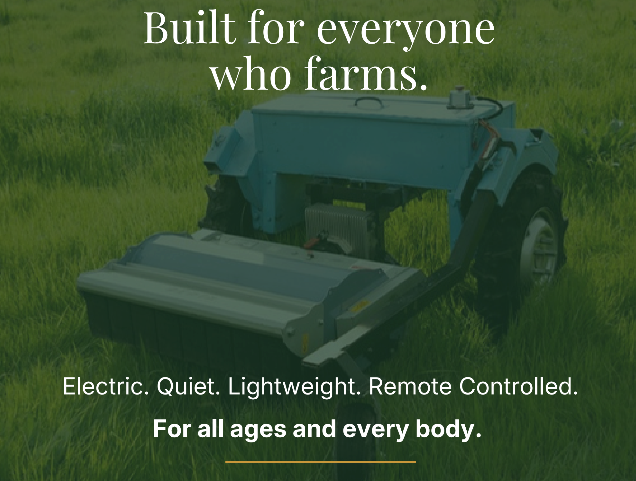
Renewables, Inc. builds electric equipment for small and diversified farms. The e2T operates substantially more quietly than diesel walk-behind equipment.
Sources
- Tak et al., "Exposure to hazardous workplace noise and use of hearing protection devices among US workers," American Journal of Industrial Medicine, 2009; cited in NIOSH Agricultural Health Data
- Masterson et al., "Prevalence of hearing loss among noise-exposed workers within the Agriculture, Forestry, Fishing, and Hunting sector, 2003–2012," PMC, 2018 - PMC
- Becot & Fetzer, "Noise-induced hearing loss in farmworkers: a scoping review," Frontiers in Public Health, 2025 - Frontiers
- McBride et al., "Noise exposure and hearing loss in Agriculture: A survey of farmers and farm workers in the Southland region of New Zealand," Journal of Occupational and Environmental Medicine, 2003 - PubMed
- Great Plains Center for Agricultural Health, "Hearing Loss Among Farmers and Agricultural Workers" - GPCAH
- NIOSH, "Noise and occupational hearing loss," 2024 - CDC