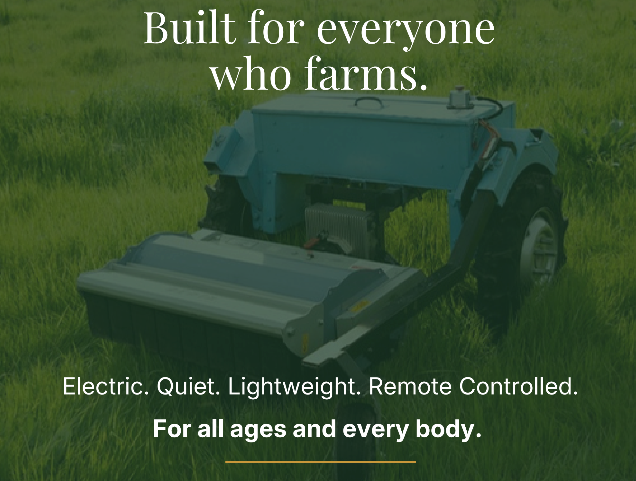
For decades, researchers studied the soil, the seeds, the air quality, and the microbiome. The combustion engine driving through the middle of it all was treated as a given. It doesn’t have to be anymore.
It started, as these things often do, with a sentence I stumbled upon that kicked off a spontaneous research deep dive.
I saw a post online that led me to an article, which led to spending my Saturday evening reading academic studies about pesticide residue on strawberries. Somewhere in it, a California-based watchdog called Mamavation had purchased organic and conventional Driscoll’s strawberries, sent them to a lab, and tested them against a panel of over 500 pesticide compounds. The conventional sample came back with PFAS-laden pesticides. The organic sample tested clean.
That part wasn’t surprising. But it sent me down a rabbit hole that ended somewhere around midnight with a question I couldn’t quite shake: if we’re measuring pesticide residue on strawberries, is anyone measuring what the tractor left behind?
Spend enough time around regenerative agriculture research and you start to appreciate how thorough it is.
Tillage. Cover crops. Soil biology. Compaction. Mycorrhizal networks. Nutrient density. Microbiome diversity. Earthworm counts. Researchers have examined these systems with academic rigor, and the body of evidence is genuinely impressive.
Then a diesel tractor drives through the middle of the test plot.
Nobody writes that down.
The more I looked, the more I became convinced this is mostly my own hypothesis at this point - but I think it’s a hypothesis worth investigating. With all the research into regenerative and organic farming practices, the impact of equipment power source seems to be a variable that’s never really been isolated and tested. Not in any systematic way. And I think that’s because you can’t study a variable you can’t change.
The input nobody counts
Regenerative farming is, at its core, an attempt to reduce harmful inputs to a farm ecosystem. People who invest in sustainable and regenerative farming systems do so because they want healthier food, cleaner air, and better soil. Synthetic fertilizers, pesticides, compaction, tillage - each of these became a study subject once researchers had something to compare against. The combustion engine got a pass, not because anyone decided it didn’t have an impact, but because it was just always there. Background infrastructure. The assumed condition.
Except it isn’t neutral. Every pass of a gas or diesel machine through a field emits particulate matter, nitrogen oxides, and hydrocarbons. In enclosed growing environments like high tunnels and greenhouses, those emissions have nowhere to go. A farmer running a walk-behind diesel tractor through a market garden is breathing exhaust at close range for hours. What ends up on the strawberries? What’s happening in the soil biology directly beneath the exhaust plume? What’s the air quality inside that tunnel by the third pass of the morning?
These aren’t new questions. They’re just questions that couldn’t be tested until someone built equipment that would allow for a practical comparison: a field-capable electric tractor that could run the same work on the same farm. That comparison is now possible, and that means the experiments finally are too.
Where are the research gaps?
Worker health is probably the most tractable place to start, and it might be the most urgent. There’s extensive literature on diesel particulate exposure, agricultural respiratory disease, noise-induced hearing loss, and vibration injuries. What’s largely missing is a direct comparison between diesel and electric equipment in real working conditions at the small-farm scale, because until recently a comparison wasn’t really possible. A well-designed study could address that fairly quickly.
Crop quality and contamination are probably the biggest blank spots. Researchers study soil fertility, irrigation, genetics, nutrients, and microbiomes in painstaking detail. The question of whether exhaust particulate deposition affects what ends up on leafy greens, berries, and herbs, especially at harvest, especially in enclosed spaces - has barely been asked. The strawberry study that sent me down this path tested for pesticides. I haven’t found one that tested for diesel particulate residue on produce grown in close proximity to combustion equipment. If that study exists, I’d genuinely love to read it.
Greenhouse and high tunnel production may be the strongest niche for this kind of research. Enclosed growing environments concentrate everything (that’s actually the point of them) and combustion emissions that disperse quickly in an open field accumulate over the course of a workday inside one. The comparison against electric equipment is unusually clean because you’re removing combustion entirely, not just reducing it. I’m not an academic researcher, but I do think there’s potential for a tidy experimental setup there.
Soil biology is more complicated and honestly may show smaller effects, or even none at all. The existing compaction literature focuses on machine weight and traffic patterns, not power source, and most soil scientists would reasonably argue the engine type is irrelevant unless it changes how the machine actually behaves in the field. Lighter electric equipment does change some of those variables, but that’s a different and more modest question.
The invisible variable
“Are electric tractors better?” is a product question. The more interesting one, or at least the one I keep coming back to is: what are the unintended biological and environmental effects of on-farm combustion engines that have never been isolated as a variable?
Regenerative agriculture has spent decades interrogating what goes into the farm system and what comes out. The machine driving through the field has been treated as a constant. It has been emitting exhaust the whole time. The research community has simply never had a practical way to find out what, exactly, that means - for the soil, for the crops, for our nutrition, or for the people doing the work.
Null results are still results. If the answer turns out to be “less than we thought,” that’s still worth knowing.
Research Question: Available for adoption, seeking good home (with a lab)
Renewables builds equipment. We’re not researchers, and we’re not claiming to be.
What we can offer is the thing that makes the experiment possible: a field-capable electric machine that can run alongside diesel equipment on the same farm, same operator, same crop, same soil. That’s a cleaner comparison than most field research gets to work with, and it didn’t exist at the small-farm scale until recently.
Maybe this question has already crossed someone’s mind in a university lab, extension office, or research program. If so, we’d love to hear about it. And if it hasn’t, perhaps we could connect for a conversation.
If you’re working in soil ecology, farm worker health, food systems, environmental health, or agricultural engineering and this has you thinking, please reach out. If you know someone these questions should reach, please pass this article along. And if you’re a farmer who has wondered about any of this while running your equipment - that kind of practical curiosity is exactly where good research questions come from.
We’re less interested in proving a point than in seeing data from independent research. The answers may be surprising. They may be boring. Either way, we’ll know more than we do today.